Why are there different grades for nylon color masterbatches, such as spinning grade, injection molding grade, and film grade?
Why are there different grades for nylon color masterbatches, such as spinning grade, injection molding grade, and film grade?
The main reason for this classification is the difference in processing conditions.
The spinning grade, injection molding grade, and film grade color masterbatches, although they all have compatible carriers with nylon substrates, have completely different processing methods, shear strength, molding speeds, and product shapes. Therefore, the formulas need to be adjusted specifically, and this is how they are classified. They cannot be used randomly.
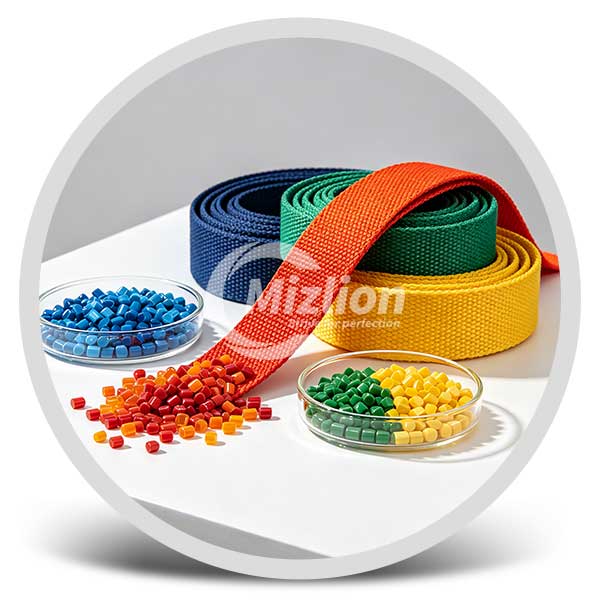
The spinning grade color masterbatch is used for fiber production. During spinning, the melt needs to pass through tiny spinnerets, and the channels are narrow, requiring extremely high dispersion. If there are agglomerated particles, it is very likely to clog the holes, cause broken fibers, and hairiness. The formula selects fine-grade pigments, combines an appropriate dispersion system suitable for spinning, and also takes into account the heat resistance at high temperatures to control precipitation and ensure uniform color of the filament and reduce color differences. It is suitable for spinning processes such as long fibers and short fibers.
The formulations for injection molding grade and film grade focus on
The injection molding grade color masterbatch is for injection molding products. During the molding process, the shear force, residence time, and spinning of the melt are different. Injection products emphasize uniform coloration, while also considering the mechanical properties of the product. The formula will balance dispersion and fluidity, adapt to different structural molds. The threshold for allowable particle sizes of impurities is higher than that of spinning grade, and it focuses on controlling flow marks and color patterns to meet the appearance requirements of products such as shells and structural components. The requirements for pigment precipitation and migration depend on the product usage scenarios.
The film grade color masterbatch is used for extrusion casting or blown film. The film thickness is thin, and the finished products are mostly transparent or semi-transparent. Minor flaws will be obvious. This type of color masterbatch requires fine dispersion of pigments to avoid crystal points and fish eyes. At the same time, it needs to control smoothness and precipitation problems to prevent fogging on the film surface and adhesion. During the stretching process of the film, the color masterbatch system needs to stretch synchronously with the substrate, without causing color discontinuities or stripes, and has special requirements for the extensibility of pigments.
The selection of pigments, dispersion aids, and lubricant systems for all three grades are carefully tailored. Cross-grade mixing poses a high risk. The spinning grade is used for injection molding and has a higher cost; the injection molding grade and film grade can be used for spinning, which is very likely to clog the plates and cause broken fibers; the spinning grade can also be used for film, but it may also result in surface defects.
When selecting, prioritize matching the molding process. Before production, conduct sample tests to observe the coloring effect, processing stability, and product appearance to ensure smooth production.
If you need sample inquiries, please feel free to contact us.